
Medellín 🇨🇴 Was Underpriced for 30 Years. Fear Was the Discount.
You can argue Medellín, Colombia is overpriced now – but you can’t argue this: It was underpriced for 30 years. The intrinsic value of the city was there the whole time: Spring weather year-round, called the “City of Eternal Spring” for a damn good reason Mountains out almost every window, some of the best non-beach views you’ll find Actually walkable neighborhoods, and better yet: you’re not drenched in sweat walking them Colombia’s only metro, running since 1995, in a city that’s proud of it Friendly, sharp locals (Paisas) who offer great energy and charm And well, the women aren’t exactly ugly either…ya tú sabes None of that is new. What’s new is that the price finally reflects it. For three decades, the legacy of Pablo Escobar kept one of the most naturally appealing cities in the hemisphere dirt cheap, long after the murder rate had fallen. Fear was the discount. That discount is gone, and you can see it in a cup of coffee. Last week I paid about $5 USD for a flat white in Poblado. My regular coffee in Costa del Este, Panama City, is $4 USD. Coffee in the country that grows it now costs more than…

Author
Jake Nomada
Published
Sep 3, 2026
Read time
10 min read
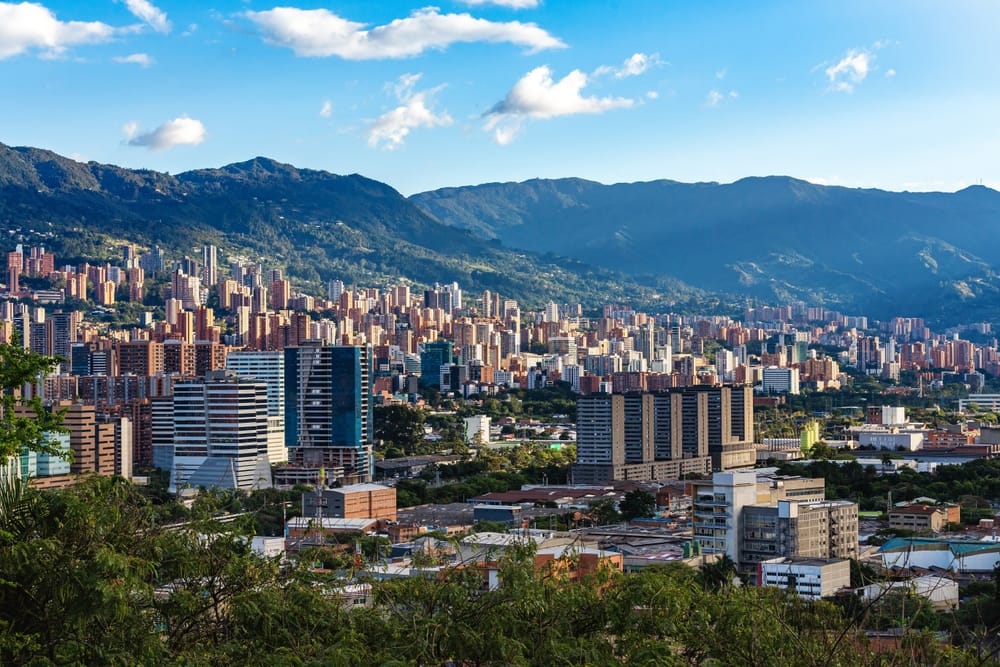
You can argue Medellín, Colombia is overpriced now – but you can’t argue this:
It was underpriced for 30 years.
The intrinsic value of the city was there the whole time:
- Spring weather year-round, called the “City of Eternal Spring” for a damn good reason
- Mountains out almost every window, some of the best non-beach views you’ll find
- Actually walkable neighborhoods, and better yet: you’re not drenched in sweat walking them
- Colombia’s only metro, running since 1995, in a city that’s proud of it
- Friendly, sharp locals (Paisas) who offer great energy and charm
And well, the women aren’t exactly ugly either…ya tú sabes
None of that is new.
What’s new is that the price finally reflects it. For three decades, the legacy of Pablo Escobar kept one of the most naturally appealing cities in the hemisphere dirt cheap, long after the murder rate had fallen.
Fear was the discount.
That discount is gone, and you can see it in a cup of coffee.
Last week I paid about $5 USD for a flat white in Poblado. My regular coffee in Costa del Este, Panama City, is $4 USD. Coffee in the country that grows it now costs more than coffee in a dollarized banking hub.
But that cup is the last page of a decades-long story. I’ve been on the ground in Latin America since 2014. My first trip to Medellín was in 2015, and I’ve had a front-row seat ever since.
Anyway, that story starts where it has to, in 1991, when Medellín was…
The Most Dangerous City on Earth
In 1991, no city on the planet had a higher murder rate than Medellín, and it wasn’t close.
→ 381 murders per 100,000 residents: over 6,300 killings in one year, in a city of about 1.7 million. The UN puts the line for “endemic violence” at 10 per 100,000. Medellín was running at nearly 40 times that.
→ Escobar put a $2,000 bounty on every police officer in the city. At least 153 were murdered in Medellín between 1990 and 1993, per Colombia’s National Center for Historical Memory. Car bombs went off in the streets and presidential candidates were assassinated. In 1989 the cartel blew Avianca Flight 203 out of the sky with 107 people on board.
→ 98% of the city’s homicides went uninvestigated and unprosecuted, according to the regional procurador in 1994. Murder was effectively legal.
That is the Medellín the world remembers, and Narcos handed it to a new generation in 2015. The reputation outlived the reality by decades. The gap between the two is where this whole story lives.
The Long Climb Down
Escobar was killed on a Medellín rooftop in December 1993. The violence didn’t die with him. The cartel splintered into gangs and militias, and the city’s murder rate ran at roughly triple the national average through the 1990s.
Medellín didn’t converge with the rest of Colombia until around 2005. It took a two-decade grind to get there.
On the security side, Operation Orión in 2002 wrested Comuna 13 from urban militias, and the paramilitary bloc that controlled much of the city demobilized in 2003. Gang truces, uncomfortable as they were, brought the killing down hard in the early 2010s.
The city also made a bet it called “social urbanism” – instead of only policing the hillside comunas, it connected them. The first Metrocable line opened in 2004, running gondolas up to Santo Domingo, one of the most violent barrios in the city.
Library parks followed from 2007, then the outdoor escalators in Comuna 13 in 2011, with a mayor, Sergio Fajardo, who made a point of putting the best architecture in the poorest places. The neighborhoods that produced the most sicarios in 1991 are tourist attractions today.
In 2013 Medellín won the Wall Street Journal and Citi’s “City of the Year” competition for the world’s most innovative city, beating New York and Tel Aviv in the final round.
The numbers:
| Year | Rate per 100K | Context |
|---|---|---|
| 1991 | 381 | The peak |
| 2005 | 37 | Converges with the national average |
| 2015 | 20 | Lowest in decades |
| 2016–18 | 22–25 | Gang turf war (Oficina vs AGC) |
| 2020–22 | 15 | Lockdown-era drop that held |
| 2024 | 11 | 300 homicides. Lowest count since 1976, lowest rate since 1942 |
| 2025 | 13 | 346 homicides |
Sources: National Center for Historical Memory, Secretaría de Seguridad de Medellín, El Tiempo, Infobae. Rates approximate; counts vary slightly by agency.
From 381 to 11 per 100,000, roughly 3% of the peak. Jackson, St. Louis, New Orleans, Memphis, and Baltimore all ran higher murder rates than Medellín in 2024.
2025 ticked back up about 5%, driven mostly by fights and personal disputes plus some turf friction involving foreign criminal groups, and I’d rather you hear that from me than find it on Reddit. Worth watching in 2026.
But going from “lowest in 80 years” to “second lowest in 80 years” is not a return to the bad old days.
The City That Lost Its “Edge”
You can feel those stats on the street.
Colombians have a saying:
“No dar papaya”
Don’t give anyone an opening or opportunity. Keep the phone in your pocket and pay attention to who’s around you. For decades that instinct ran your day-to-day life in Medellín – both for locals and foreigners alike.
Walk around Poblado or Laureles at night in 2026 and it’s damn near gone. Phones sit out on sidewalk tables and people walk home at midnight without checking over their shoulder. I say that as someone who still stays switched on in most Latin American cities out of habit, and I didn’t feel the need to.
Now…
Many have argued with me that I’m wrong. That Medellín is more dangerous than ever, even when I show them these stats.
Something about foreigners never being targets for murder anyway, something about scopolamine getting expats daily, something about street crime and robberies worse than ever before.
Blah, blah, blah.
I disagree. And even if the stats don’t tell the whole story, the types of people visiting the city these days do.
Who’s Actually in Medellín Now
Medellín has more foreigners than ever, but the raw number matters less than the type.
Because if it’s 99% single males, then that’s not exactly a big change. Single men have been visiting Medellín on a consistent basis for the past 20+ years.
But that’s not what I saw walking around Poblado this time. Retirees at the cafés, European girls on vacation walking around Provenza at midnight, families with realtors, etc.
The single bros are still the biggest crowd, but they’re a crowd among several others now, and that’s the change.
Here’s how it happened, wave by wave:
- 2015, when I first showed up: adventurous expats and a certain “type” of tourist. Medellín still had the narco reputation and a sex tourism problem. The foreigners here were either the adventurous kind or here for reasons they didn’t put on Instagram.
- 2016 to 2018: the secret gets out. JetBlue and Spirit started flying direct, and the city went from a connection through Bogotá to a short flight from Fort Lauderdale. The blog posts and “most underrated city in Latin America” videos followed. The people who bought in this window are sitting on the best cost basis of anyone.
- 2022: the digital nomad flood. After COVID, an estimated 8,300 nomads a month were arriving at the peak, behind only Mexico City and Buenos Aires in the region. Colombia launched a digital nomad visa that year. Provenza turned into an open-air coworking space.
- 2024: the crackdown. The old reputation made international headlines one last time, after a US tourist was caught with two minors in a Poblado hotel that March, and the city responded aggressively. Mayor Federico Gutiérrez banned paid sex work in Poblado and Provenza, bars closed early, Airbnb delisted over 150 properties in coordination with the mayor’s office, and Migración Colombia started turning suspected sex tourists around at the airport. Over 100 foreigners were denied entry in 2025, most of them Americans. The crackdown filtered the boom more than it shrank it.
- 2026: retirees and girls’ trips. Medellín pulled nearly 1.2 million foreign visitors in 2025, a record, and tourism generated close to $3 billion.
But the composition is the story.
See, you still have the single males, the digital nomads, etc. On top of that, you now have…
→ Retirees, the 70-year-old European couples strolling Laureles with expensive cameras out, stretching pensions in a city with real healthcare
→ Young women on vacation: groups and solo travelers walking Provenza at midnight. That crowd shows up in exactly one kind of city, the kind where the risk is almost gone
Pioneers and/or degenerates happily accept risk and get paid for it with cheap prices.
Retirees and girls’ trips accept none, so once they showed up, the fear discount was over.
A former Airbnb employee bought a $492K penthouse in El Poblado, Medellín.
The previous owner was grossing about $42K/year on it.
He’s now doing $150K+. Roughly $18K a month.
Same building. Same location. Same 4 bed / 4 bath layout.
What changed was the operation: the $20,000 painting mistake he fixed, a hot tub trick that quadrupled bookings, pricing that flexes between high and low season, and a guest profile he built the whole place around (four guys, 3.5 nights, 90% North American).
Net of ~$40K in costs, that’s a 23% cap rate in a market where most Airbnbs struggle to hit 8-10%.
I filmed the full walkthrough with him, plus the parts people skip: which buildings in Medellín actually allow STRs, the two streets in Poblado that make or break you, and whether the city is saturated (we found 78 listings in 10 minutes).
Why the Resentment Is Fading
Every city that “pops” or “booms” in Latin America typically develops a “locals vs. foreigners” narrative. Take Mexico City for example and their “gringo go home” marches:
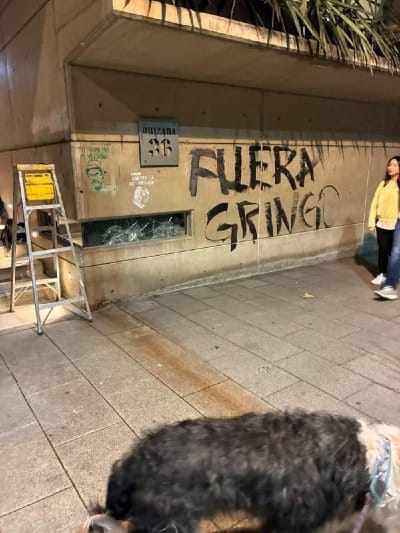
Medellín had a similar issue: the posters on the street, the graffiti, and the fight over Airbnb.
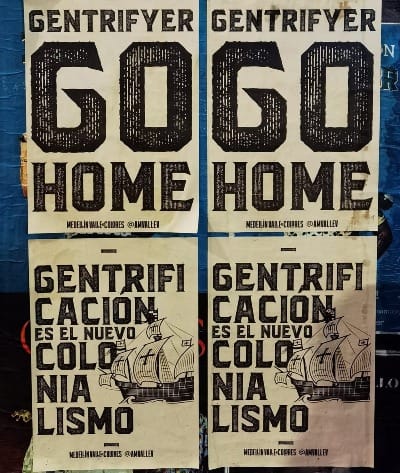
Some of it is still there, and some of it is fair. Rents in the tourist zones priced out locals who lived there first. Hell, we may be starting to see this in Laureles too.
What the backlash story misses is who else made money…
Locals in Medellín weren’t spectators to this boom. They were owners of it.
Paisa families who held property through the boom created serious wealth. The ones who built businesses on top of it (restaurants, tour companies, brokerages, builders) made even more.
They had the capital to do it. Medellín was Colombia’s industrial city long before it was anyone’s tourist city, home to the textile mills and later the Grupo Empresarial Antioqueño conglomerates (Bancolombia, Argos, Sura, Nutresa), with a professional class that had savings and access to local bank financing.
When one in four properties sold in Medellín in 2024 went to foreigners, that means three in four went to Colombians, many of them buying with money the boom itself generated. Property values across the city rose over 10% in 2025, the fastest of any major Colombian city, and most of that appreciation landed in local hands.
Then there’s the human layer.
Thousands of mixed families came out of those same years. Kids who grew up bilingual with a foot in both countries. Paisa grandmothers with a gringo son-in-law at Sunday lunch and grandkids who carry US passports. I’ve watched it happen in friends’ families across the region for over a decade, and Medellín is where I’ve seen the most of it.
It’s hard to resent a boom your own family built wealth in. It’s even harder to resent a foreigner who’s now your brother-in-law.
Most takes on Medellín skip this part.
Booms that stay “foreigners extracting, locals watching” eventually snap back, at the ballot box or in the street. Booms where locals compound wealth alongside the newcomers tend to stick. Medellín is the second kind. Not everywhere, but enough that the trajectory feels durable in a way it didn’t in 2022.
Which Brings Us Back to That Coffee…
A $5 flat white in Provenza. A $4 one in Panama City, a dollarized banking hub.
The tourist-zone premium is doing some of that work: the coffee that costs 5,000 pesos in Medellín’s Centro costs 15,000 in Provenza, and citywide, Medellín is still cheaper than Panama City.
But the crossover on the blocks where foreigners actually buy is the tell, and the coffee is the small version of what’s happening in property:
→ El Poblado’s pricing. The new-build prices here ground upward for a decade, then jumped. In 2013, La Lonja de Propiedad Raíz, Medellín’s real estate guild, had new apartments there averaging just over COP 5 million per m². By 2024 the most expensive pre-sale units had hit COP 15.4 million, up 50% on the 2020 peak, and the builders’ association Camacol Antioquia now puts Poblado and Envigado averages at COP 8.5 to 12 million. In pesos that’s a double since 2013, with most of the move after 2020.
→ Other areas are repricing too. Camacol Antioquia’s 2026 numbers have Envigado matching El Poblado at COP 8.5 to 12 million per m², with Sabaneta and Itagüí at 5.5 to 6.1 million and Bello around 4.8 million. Envigado was the discount to Poblado a decade ago. It isn’t anymore. And Laureles, the flat, walkable neighborhood that used to be the value play, is now the most-searched zone in the city according to the Lonja.
→ Expensive in dollars now. The dollar math depends on when you measure from. Against 2013, when the peso sat near 1,900, that COP 5 million Poblado apartment was about $2,700 per m², not far below today’s average. A decade of peso devaluation kept Medellín cheap in dollars while it got expensive in pesos. Against the late-2022 trough, around 4,800 to the dollar, a top Poblado pre-sale cost roughly $2,300 per m². At today’s 3,100 to 3,200, the same unit runs $4,000 to $5,000. A dollar buyer’s cost basis doubled in under four years, and only about half of that came from peso prices. The exchange rate did the other half.
That’s why Medellín “suddenly” feels expensive to dollar earners. 2020 to 2022 was a double discount: fear pricing and a weak peso.
Both are damn near gone.

What This Means If You’re Looking at Medellín Now
You missed dirt cheap. You didn’t necessarily miss the trade. The fear discount is gone, and hopefully it isn’t coming back.
What you’re buying in 2026 is a functioning, well-connected city of 4.1 million (metro) at prices that are fair-ish instead of absurd.
Relative value still exists, just not on the most popular blocks. Provenza and the Poblado golden triangle are not cheap any more. Belén, Sabaneta, the edges of Envigado, and the Ciudad del Río spillover still trade at a discount. Laureles has pumped.
If Medellín is a pure investment, you’re timing the peso right now, not the city.
Half the dollar move since 2022 was the exchange rate, and the peso swings hard: 2,750 in 2015, 4,800 in 2022, 3,150 today. In my opinion, the setup you want is 2021 without the fear: peso prices climbing, exchange rate blown out.
It’ll come again. Eventually.
Know the risks either way: the Airbnb decree, the 2025 crime uptick, and a peso that can move against you on the exit too.
For 30 years, fear kept one of the better cities in Latin America dirt cheap. A $5 flat white in Provenza says that era is over.
The next discount comes from the peso…again. Be ready for it.
Ya tú sabes,
Jake Nomada