
Is Playa Caracol 🇵🇦 Actually Worth the Hype?
Is Playa Caracol the best beachfront buy in Panama, or just the best marketed? Four days there with my kids gave me the answer.

Author
Jake Nomada
Published
Aug 18, 2026
Read time
21 min read
In what little down time I get with so many offspring, I unwind by watching an embarrassing amount of international real estate and relocation content.
I’ve been living in Latin America for 12+ years, have invested a decent chunk of change in real estate in the region, and my parents had me tested as a kid because I was good with math (whatever they found has mostly worn off, but the phone calculator still works, and that’s all this article requires).
So I suppose it kinda adds up.
And something you notice when you watch this type of content in Latin America: when Panama comes up, everybody and they mama wants to show you Playa Caracol.
You might have seen the hype…
- “Panama’s Hidden Riviera”
- “The Coastal Community Panama Has Been Missing”
- “Panama’s New Lifestyle Destination”
- “The New Oceanfront Paradise in Panama”
- “One of the Best Places to Retire in Panama”
- “The Best Value Beachfront in the World”
I could keep going, but I’ll stop there. I think you catch my drift.
Playa Caracol has been hyped to the moon and back by damn near everyone who speaks about real estate in Panama.
Why is that? Why does everyone in the industry treat it like the best thing to happen to Panama since the canal?
I was curious. So I had to check it out for myself. To see if Playa Caracol could live up to the insane amount of hype.
So I loaded up the car, buckled the kids in, and headed west from Costa del Este.
What I found was more complicated than the highlight reels.
Some of the hype is more than earned. Some of it is exactly that: hype. Let me walk you through both sides of the equation.
What is Playa Caracol?
Simply put…
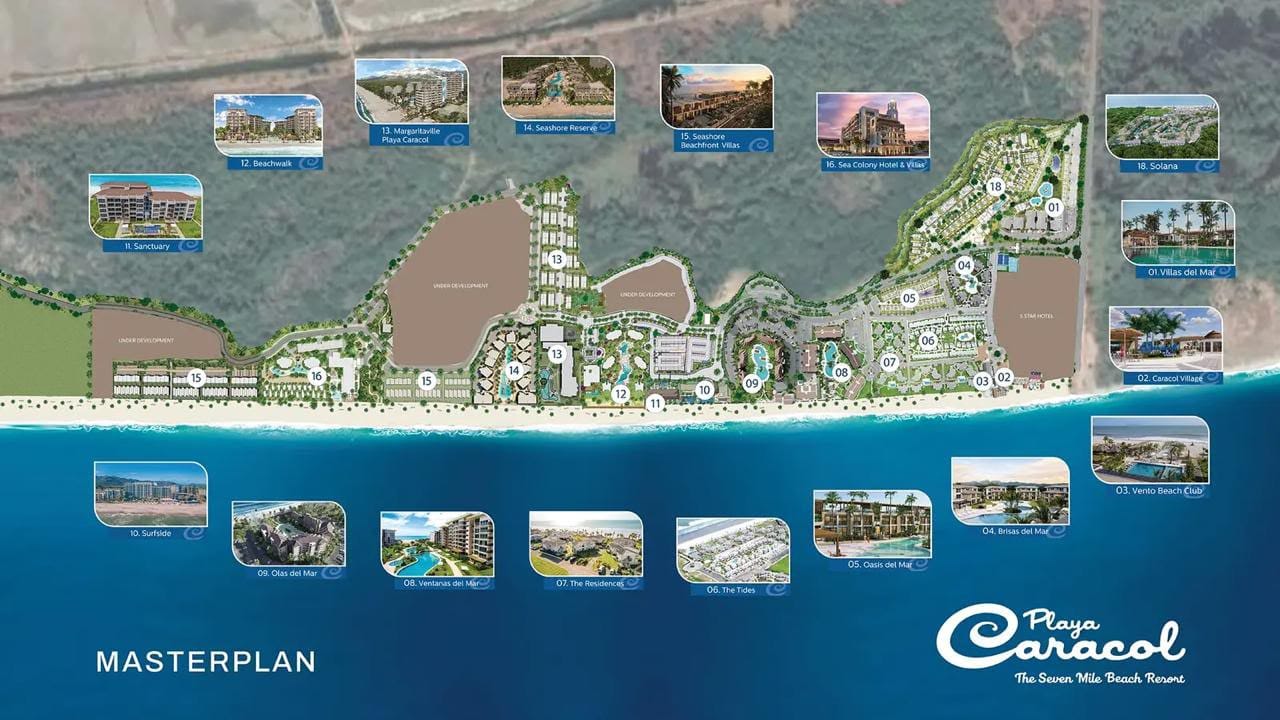
Playa Caracol is a master-planned, gated beach community on Panama’s Pacific coast, in the Chame district west of Panama City.
It’s the vision of Alfredo Alemán and his company Grupo Los Pueblos, one of the most established developers in the country. The group behind landmarks like Albrook Mall and the man-made Ocean Reef Islands.
But it’s more than that, see…
Grupo Los Pueblos owns the entire beach. Seven miles of it, branded conveniently as the “Seven Mile Beach,” all under one developer. Roughly 2.5 of those seven miles have been built so far.
That single fact cuts both ways, and we’ll talk about it again shortly.
But for now, one developer means a controlled, coherent vision instead of a chaotic mix. It also means the place has a ways to go.
So what do people actually do out here?
More than you’d think for a place still being built. Day to day, residents and guests have access to:
- Surfing — the main draw, with consistent left and right beach breaks that work best at low tide, plus a surf club renting boards
- Kitesurfing — Punta Chame next door is one of Panama’s top kite spots, best wind December to April
- The beach club and pools — beachfront pools, loungers, palapas, and beach bars
- The Radisson Hotel amenities — spa, gym, and restaurants, all open to the community
- Fishing and whale watching — boats run offshore, with humpback season running roughly July through October
- Hiking — Cerro Chame rises right behind the community
- Family stuff — playgrounds, BBQ gazebos, basketball and tennis courts, etc.
- Beach walks — there’s seven miles of beach to walk and explore here
A word of honesty:
A lot more is promised than currently exists. A village-style shopping center, a seaside promenade, a supermarket, and a sports academy are all “in development” as of now. The good news? As of mid-2026, you can see some of those amenities starting to go up.
For now, the lifestyle is sun, surf, sand, and the hotel. The “beach town” around it is still mostly a rendering.
Where is Playa Caracol Located?
Playa Caracol sits at the base of the Punta Chame peninsula in Panama’s Chame district, on the Pacific coast about 75 km west of Panama City.
Realistically, it’s a 90-minute drive on the Pan-American Highway, longer if you hit traffic leaving the city. The drive is easy though, mostly four-lane highway once you’re clear of the city, and once you cross the bridge it’s lush and green. A pretty drive, to say the least.
And that proximity to the capital paints a pretty picture.
This is the closest real beach destination to Panama City that doesn’t require getting on a yacht or a prop plane. Which is why people treat it as the city’s weekend getaway beach.
The nearest town to Playa Caracol is Coronado, 20 to 30 minutes further west. Coronado has been Panama’s beach-retiree hub for decades, and it shows. It’s got the supermarkets, pharmacies, medical clinics, banks, and restaurants that Playa Caracol simply doesn’t have yet, so it’s where you’ll run errands and stock the fridge for longer stays.
What Coronado doesn’t have is the beach. Well, it does, but its sand is darker, grayer, and rockier, and in my opinion the beach at Playa Caracol blows Coronado out of the water. Maybe a personal opinion, but I just far preferred the beach at Caracol. You go to Coronado for the services. You don’t go for the sand.
For flying, two airports matter. Tocumen, the main international hub, sits east of Panama City and is about two hours from Playa Caracol.
But closer, and on this side of the canal, is Panamá Pacífico (BLB), which is Wingo’s base, with direct budget flights to Colombia: Bogotá, Medellín, Cartagena, and more.
Won’t matter for everyone, but nice to have for some.
Why Does This Stretch of Coast Suddenly Matter?
I mean, it’s pretty simple…
Because the government is spending billions to open up the whole corridor. Point. Blank. Period.
And it helps that the country’s biggest developer decided to plant its flag right in the path of all that spending.
What spending exactly, you might ask?
Well, a widened highway runs west out of the city. A fourth canal bridge is under construction as we speak, targeting completion in 2028. And the metro is reaching into the western suburbs.
Then the big one is President Mulino’s flagship:
$4-5 billion railway from Panama City to David, with a planned stop at Chame/Coronado minutes away
It’s a real government priority, but studies are still underway and it hasn’t broken ground, so treat it as a tailwind, not a promise. Worth noting too: the Chame/Coronado stop sits in the full route vision, not the first funded phase. Don’t buy a condo based on a train station.
The direction, though, is unmistakable. Money and infrastructure are moving west.
Here’s why that matters to you:
Every one of those projects shrinks the distance between Playa Caracol and the city, and access is what turns a remote beach into a viable second home, then a viable full-time one.
The buyers getting in now are pricing today’s 90-minute drive, not the 45-minute one the government is busy building toward. That gap, between what the coast is today and what the infrastructure is dragging it toward, is part of the thesis here.
It’s also why global brands like Radisson and Margaritaville are planting flags out here before the concrete’s even dry. They’re not betting on the beach as it is. They’re betting on where it’s headed.
My Experience in Playa Caracol
So I went. And not for a quick one-day, in-and-out tour.
We packed up the whole family and stayed for four days. If you want to know whether a place actually works, a property tour tells you some of it. Three nights with kids tells you the rest.
Our days fell into a rhythm fast.
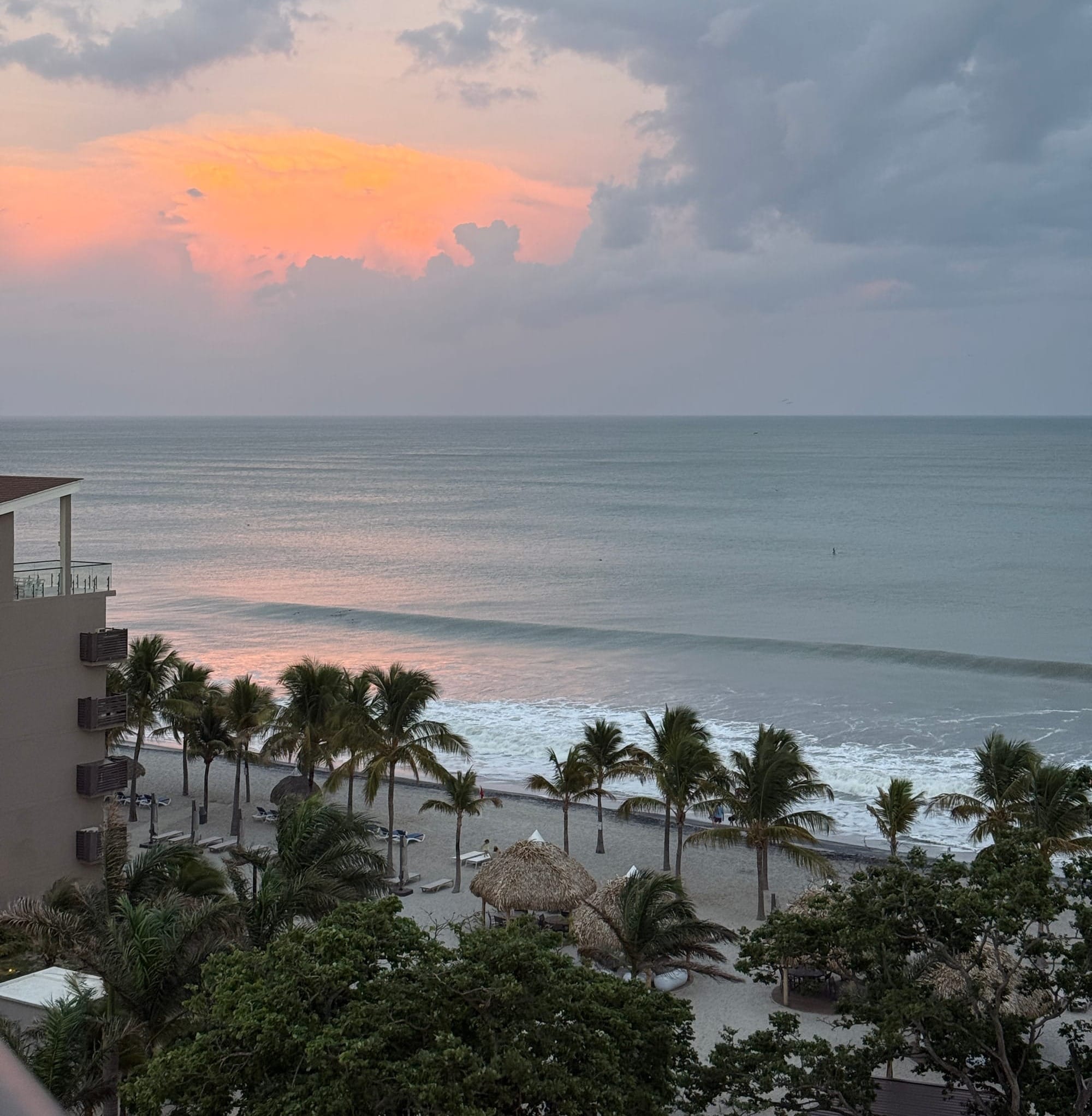
Early morning beach walks “hunting” seashells with my kids, the sand basically empty at that hour except for a few surfers already out in the lineup. Swimming in the resort-style pool, taking the little ones down the slide more times than my lower back appreciated. Dips in the ocean when the heat picks up and the tide goes out.
It’s the kind of place where the days fill themselves, which is exactly what you want a family beach trip to do.
The beach is where I took some real notes.
Let me be straight about the water:
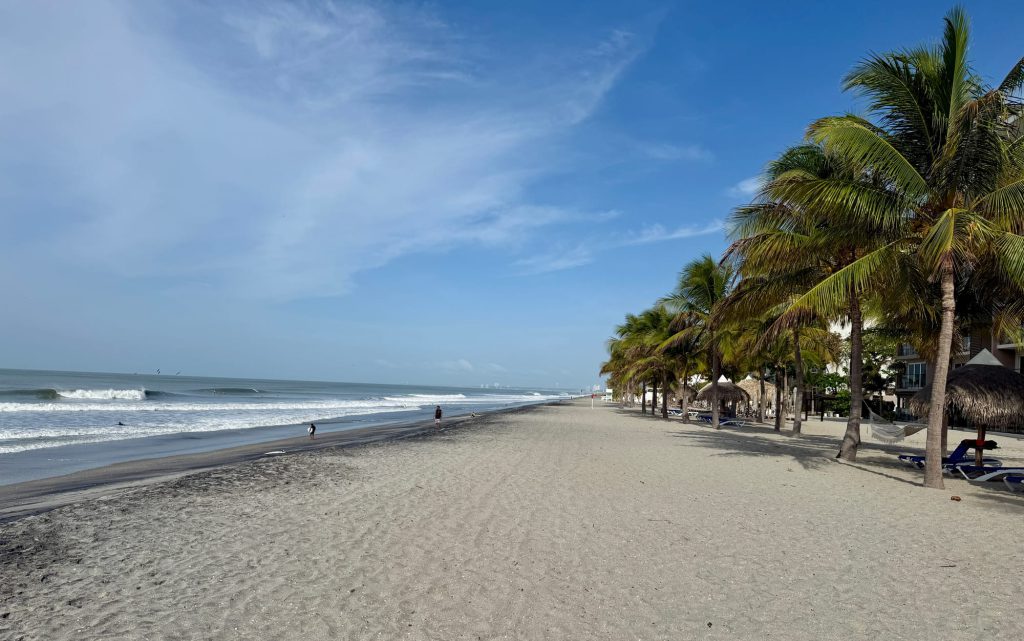
This is the Pacific, not the Caribbean. If you’re picturing crystal-clear turquoise, Caracol isn’t for you. But, and this is important, the water was better than I expected. On a sunny day it picks up a nice green hue and the ocean is genuinely stunning. Overcast, it goes gray. That’s the honest range.
The surf is legitimate too. Those surfers weren’t out there at the ass-crack of dawn for nothing.
In between family time, I toured units across the communities, both built and pre-construction.
The Radisson Riviera is up and running, and it’s the closest thing the place has to a center of gravity, the spot everything else orbits as of now.
Surfside’s residences are in the finishing stretch, units being delivered as I write this. Olas del Mar is a wonderful beachfront product, ideally suited for families. Brisas del Mar sits quieter and further back, low-rise, more “live here” than “vacation here” in some ways. I checked out one of the older beachfront communities too, called Sanctuary. Seashore, the highest-end of the bunch, is still a hard-hat zone of cranes and poured concrete, with a sales gallery doing the talking. And Margaritaville, the one that’ll put this place on the international map, is under construction down the beach.
What struck me most, though, was the in-between. Finished towers, then empty lots. A working hotel, then a stretch of sand with nobody on it. The place swings between “already here” and “still coming,” and that contrast shaped my entire verdict.
The “Earned” Hype
Let’s start with what Playa Caracol gets right, because plenty of it is real. The hype is earned in many respects.
Hell, my kids are already asking to go back, so something went right…
The Beach Was Better Than I Expected
I drove out expecting an overhyped strip of average sand, and that’s not what I found. The beach is wide, clean, soft, and walkable for miles, and it wasn’t a good first impression that faded. It got better as the stay went on.
And the comparison that matters: Coronado, the established beach hub twenty minutes away, has been pulling expats for fifty years with a noticeably worse beach. The newcomer has the better product. That almost never happens.
True Beachfront, With Ocean Views From Most Units
“Beachfront” is the most abused word in international real estate. It usually means ocean view. Or a five-minute walk. Or a road and a parking lot between you and the sand.
Here, it means beachfront. Toes in the sand. You step out the door and you’re on it.
And the views run deeper than the front row: the way the communities are laid out, most units I toured had some version of an ocean view, not just the premium stack.
Resort-Style Amenities Are Here Now, With More Coming
This isn’t a “future amenities” pitch. The Radisson Riviera is open and operating, and it functions as the de facto town center: pools, restaurants, a gym, a beach club with an actual pulse. We ate well for four days without leaving the gate.
The pipeline is real too. Margaritaville is under construction down the beach, due in 2027, bringing 261 residences and a global brand’s marketing machine with it.
What you can use today is solid. What’s coming is an improvement.
Affordable to Rent, Affordable to Buy
Here’s the spread, from someone who actually walked the units: entry starts around $150K for something tucked back from the beachfront in one of the older communities, and runs to roughly $1.5M for a luxury penthouse in Margaritaville. That’s a 10x range inside one gate.
The sweet spot sits in the middle. Olas del Mar, the polished beachfront product I toured, starts around $256K for a two-bedroom and climbs close to $400K as the units get bigger.
Read that again: genuine on-the-sand beachfront, an hour and a half from a capital city, for the price of a mid-tier condo in the States.
And here’s the part people miss. The $150K buyer and the $1.5M buyer share the same beach, the same seven miles of sand, the same security, the same growing pile of amenities. The beach doesn’t know what you paid.
Because there’s a rental scene here too, you can book a unit for a week and test the place before you ever talk to a sales office. Try the product before you buy it. Not many pre-construction markets let you do that.
I went mid-week and paid $135 a night (mid-week, low season rate) for a three-bedroom in a brand new community with an ocean-view balcony and a 20-second walk to the sand.
An Easy Trip From the City
I won’t re-run the geography, but the practical point belongs here:
This is close enough to Panama City for a Friday-afternoon decision. That’s what makes the weekend-place math work, what feeds the rental demand, and what separates Caracol from every “paradise” that’s a flight and a ferry away.
The capital’s money needs a beach. This is the nearest good one.
Genuinely Kid-Friendly (With a Caveat)
Let me be specific about what a family trip here looks like, because “family-friendly” means different things to different folks.
My kids spent entire mornings collecting seashells and they never got bored. The pools are resort-grade, and the slide got more mileage than any toy we’ve ever bought them. The playground at Olas del Mar got used on a daily basis.
But the real luxury was the logistics, or rather, the lack of them. One gate, no traffic, no crowds, nothing to really manage. The kids ran loose all week and we never once had the “where-are-they!” jolt every parent knows. For four days, parenting was easy mode. That says everything about how safe the place feels.
That’s the test some “family-friendly” destinations fail: whether the parents actually get to relax too. We did.
One honest qualifier I’ll expand on later: all of this applies to a family vacation.
Living here full-time with kids is a different question, and the answer isn’t yes yet. But for a week with your family? Well, my family quite enjoyed it.
Mountain Views and Real Hiking, Right Out the Back
Watch enough Playa Caracol drone footage and you’ll spot a big green mountain photobombing half the shots.
That’s Cerro Chame, a 525-meter dome rising straight up behind the community, and it’s not just a backdrop. It’s a real hike, about two hours to the summit, and the payoff is a panorama that runs from Panama City on one side to the Azuero Peninsula on the other, with the whole Punta Chame peninsula and your beach laid out below you.
Caracol gives you a morning summit and an afternoon swim in the same day, with mountain bike trails on the hill and waterfalls about 45 minutes inland for good measure. For the active crowd, that back-door mountain might quietly be one of the best things about the place.
The People Behind It Are the Real Deal
The quiet de-risker.
Pre-construction anywhere in Latin America lives or dies on the developer, and this is Grupo Los Pueblos: Albrook Mall, Ocean Reef, Santa María, decades of delivered projects.
One developer owns all seven miles, so there’s no patchwork of competing builders, just one vision being executed in phases. And the brands betting on them, Radisson already open, Margaritaville on the way, ran their own due diligence before planting flags.
When the question is “will the rest of this place actually get built?”, the answer here is about as strong as Panama can offer.
Personally, I’d have very little stress about delivery when buying a Grupo Los Pueblos pre-construction product.
Is There a Catch?
Of course there is. There always is. A handful of them, actually. Are they dealbreakers? Well, that depends on who you are and what you’re looking for from Playa Caracol.
Here’s what I noticed:
The Community Isn’t Close to Completed
Remember the number from the top: seven miles of beach, about 2.5 built. That’s not a knock on the vision. It is the reality of what you’re buying into.
There’s no supermarket inside the gate, although there is a corner store. No main street. No school, no medical clinic, no town square where life happens on its own.
The Radisson plays the role of town center, and a hotel, however nice, is not a town. The shopping village, the promenade, the supermarket are all coming soon, but none of them are here yet.
Not Full-Time Livable for Families…Yet
My honest take as a guy raising a family in Panama:
Playa Caracol is not full-time livable for families right now.
Not because anything’s wrong with it, but because the things a family leans on every day aren’t out here yet.
There’s no school. No pediatrician. No emergency room within a 10-to-15-minute drive, which is the one that should stop you cold, because with kids, the day you need an ER you need it now, not 30 minutes up the highway in Coronado. Add a doctor’s visit, a dentist, after-school anything, and you’re looking at a life built around the drive into Coronado.
Then there’s the construction. The next several years out here are building years: cranes, trucks, dust. Seashore is a full hard-hat zone today, and Margaritaville won’t open until 2027. Buy now and you’re not just waiting for the finished vision, you’re living inside the building of it.
For a weekend place, it’s irrelevant. The construction never bothered us on our trip, and Grupo Los Pueblos manages the disruption well. But for your kids’ childhood, in my opinion, Playa Caracol is not there yet.
The Water Is Pacific, and It Always Will Be
I covered this in my experience, but it belongs on the official list because it’s the filter question.
If your dream is Caribbean turquoise, glassy and crystal-clear and swimmable for hours, Playa Caracol isn’t for you, and no amount of development will change it.
This is the Pacific. Gorgeous green on a sunny day, gray under clouds, real surf, real tides. I came away pleasantly surprised, but I went in knowing which ocean I was visiting. Make sure you do too.
Services Are a Drive Away
Inside the gate, you’ve got some decent restaurants, not many but a few. Then you’ve got a mini-mart, and it’s better than it has any right to be. Decent selection, fair prices, which almost never happens in a captive-audience spot where a gallon of milk usually costs whatever they feel like charging. There’s even a pharmacy vending machine for anything that doesn’t need a prescription.
But that’s the ceiling for now.
A real grocery run, a doctor, a hardware store, an actual pharmacist, that’s 20 to 30 minutes to Coronado. We made the drive ourselves. It’s painless as an errand and meaningful as a lifestyle: every forgotten ingredient, every prescription, every “we’re out of diapers” becomes a 40-minute round trip. Vacationers won’t care.
Residents will feel it weekly, until the on-site commercial village actually exists.
The Resale Market Is Still Maturing
One for the spreadsheet crowd…
The buildings are real and the quality is there. But here’s something the sales pitch tends to gloss over:
With Grupo Los Pueblos still building out over four of the seven miles, a lot of the buying demand goes to their new inventory first. So if you want to sell your unit in a few years, you may be listing alongside fresh developer product in the same community, with full marketing behind it. It’s not impossible to sell into that, but it can mean pricing competitively to move.
Of course, this isn’t a brand-new market with no transactions.
Units here have changed hands for years. But the secondary market is still on the thinner side while the developer remains the dominant seller. As the build-out matures and more owners resell, that should naturally balance out. For now, just go in knowing resale liquidity isn’t as deep as other similar communities in Panama as of yet.
The Numbers Nobody Puts in the Brochure
You’ve seen the asking prices. Here’s the rest of the math, because a beach condo is a monthly relationship, not a one-time purchase, and this is the stuff the glossy renders never mention.
HOA and maintenance. Playa Caracol condos generally run $150 to $350 a month depending on the community and unit size. The newer beachfront product prices per square meter: roughly $2.50 per m² monthly at Seashore and about $3.00 per m² at Olas del Mar. So a typical 80 m² two-bedroom at Olas del Mar is around $240 a month before utilities. Not brutal by beachfront standards, but it’s $2,000-4,000 a year that comes off any rental income before you count a single booking.
Property taxes. This is where Panama quietly flexes, though not the way older articles describe it. You’ll still see “20-year tax exoneration” repeated all over the internet. That was real, but the law changed: the old improvements exemption was eliminated by Law 66 of 2017, so it doesn’t apply to the new product being delivered here. What replaced it is simply low rates. An investment property pays nothing on the first $30,000 of registered value, 0.6 percent from there to $250,000, and 0.8 percent on the slice above that. And it’s graduated, so run it on a real unit: a $256,000 two-bedroom at Olas del Mar held as a vacation rental works out to roughly $1,370 a year. Make it your primary residence and it drops further, since the first $120,000 becomes exempt and the rate falls to 0.5 percent, putting the same unit around $680.
Financing, if you need it. Foreigners can get Panamanian mortgages, but come prepared: expect 30 to 50 percent down, rates in the 6.5 to 9 percent range, shorter terms than you’re used to, plus mandatory life and fire insurance bundled in. Most pre-construction buyers here skip the bank entirely and use the developer’s payment plan during construction (if available), which is typically a percentage down and staged payments until delivery. If you’re a cash buyer, none of this matters and you’re the sales office’s favorite person.
Closing costs. Panama’s transfer tax is 2 percent, paid by the seller. As the buyer, budget roughly 1 to 2 percent for legal fees, registration, and due diligence. On new developer product, closing is simpler than resale, but get your own lawyer anyway. Always. Everywhere in Latin America.
Title. Playa Caracol units are fully titled property, which matters twice. First, because plenty of coastal land in Chame and beyond is rights-of-possession, a legal gray zone I’d steer most foreign buyers away from. Second, because the Qualified Investor Visa requires titled property. An ROP beach lot doesn’t qualify no matter what it costs.
And now the number that should reset your expectations: rental income.
I told you earlier to treat rental income as upside rather than the plan. Here’s why.
Short-term rental data for the Chame district shows average occupancy around 24 percent, with nightly rates around $160. Run the math yourself: 24 percent of the year is about 88 booked nights, and 88 nights at $160 works out to roughly $14,000 a year in gross revenue for a typical listing.
Coronado, with decades of head start, fills slightly more nights at around 26 percent occupancy, but at lower nightly rates, so a typical listing there grosses less, around $11,500 a year. Worth pausing on that. The newer stretch of coast is already commanding a premium per night over the established one. Guests will pay more to sleep on the better sand.
Still, neither number pays a mortgage, so to speak. For contrast, Buenaventura, the mature luxury resort community further west, pulls around $49,000 a year per listing. That’s what this coast produces when the community is finished and the brand has weight behind it. It is not what Chame produces today.
This coast is a weekend and dry-season market right now. Units fill Friday to Sunday and through high season, then sit quiet midweek in the green months. That’s not a Playa Caracol problem. It’s the current reality of the whole corridor, and it’s exactly what you’d expect from a destination 90 minutes from its customer base and still under construction.
The bull case is that this changes.
The train shortens the trip and the amenities fill in, while Margaritaville’s marketing machine starts putting heads in beds year-round. If that happens, occupancy is the number that moves most. Playa Caracol already wins on rate. Close the occupancy gap with Buenaventura and the revenue follows.
And here’s why that trajectory matters for buyers at today’s prices. One caveat first: Buenaventura’s $49,000 average comes from a rental pool that runs from condos up to multi-million-dollar beachfront villas, so don’t divide that number by Caracol’s entry price and call it a yield.
What Buenaventura proves is simpler and more useful: when a master-planned community on this coast is finished, branded, and amenity-rich, the weekend market becomes a year-round one.
Now apply that to Caracol…
One more thing about that $14,000 figure: it’s a district average, blending Caracol’s gated beachfront product with every scattered rental in Chame, from Gorgona apartments to Punta Chame kite-camp houses. Caracol itself already performs above the blend. A typical two or three bedroom inside the gates books around 125 nights a year at roughly $175 a night, call it $22,000 gross. That’s today, with the community half built and no train. Grow occupancy to just half the calendar, a modest bar for a finished branded resort, and the same unit grosses north of $31,000 at flat rates, on a purchase price starting around $250,000 for oceanview units.
And rates won’t stay flat in a community that already commands the corridor’s premium and keeps adding reasons to pay it. That’s the asymmetry: the downside is today’s numbers, which you already know, and the upside is a maturation story this exact coast has already demonstrated once. I think it happens sooner rather than later.
But you buy on today’s numbers and let tomorrow’s be the bonus. Anyone selling you Playa Caracol on projected rental yield is selling you the rendering, not the building.
How Playa Caracol stacks up against the neighbors:
| Playa Caracol | Coronado | Buenaventura | Vista Mar | Santa María (PTY) | |
|---|---|---|---|---|---|
| Drive from PTY | ~1h 30m | ~1h 45m | ~2h | ~1h 50m | In the city |
| Beach quality | Best in class for the corridor | Dark volcanic sand | Good, groomed | Decent | No beach, golf and marina |
| Entry price | ~$150K+ | ~$150K+ | $400K+ | ~$180K+ | $500K+ |
| Community maturity | Building out | Fully established | Established luxury | Established | Established |
| Avg nightly rate | ~$175 | Lower | Premium | n/a | n/a |
| Occupancy | ~34% | ~26% | Highest on the coast | n/a | n/a |
| Gross STR revenue/yr* | ~$22K | ~$11.5K | ~$49K | n/a | n/a |
| The one-liner | Best beach, still cooking | Best services, worst sand | The finished dream, at 3x the price | The lower-key middle option | City living with GLP pedigree |
*Playa Caracol figures are estimates for a typical 2-3BR inside the community; the Chame district-wide average is ~$14K. Buenaventura’s average spans condos through luxury villas. Santa María is included because it’s the same developer’s city product, and a real alternative for the same buyer.
The Appreciation Track Record
So with all those caveats on the table, why are people still buying?
Because the thesis is bigger than this year’s occupancy numbers: Panama keeps booming, and Grupo Los Pueblos finishes what it started, turning Playa Caracol into the premier beach destination near the capital.
I think that’s credible. And the strongest evidence isn’t a rendering or a sales pitch. It’s the price history, which anyone can trace through public listings.
The pattern is simple: every phase of this build-out has launched above the last, and asking prices have followed. Two examples, one with a six-year track record, one still unfolding.
Start with Surfside. The few remaining condos there are listing between $375,000 and $430,000 today. Real Estate Trend Alert (aka RETA) reports its members entered around $214,600 back in 2020. Now, that entry was on the first building in Surfside, and later buildings launched higher, so if anything the comparison undersells it. Either way, today’s asks are public, and they sit far above anything this community launched at.
Now Seashore, the newest and highest-end community on the sand, still about a year from delivery. The frontline villas there are already sold out. RETA reports its members got in around $520,000 at launch, and the last available unit closed in May 2026 at roughly $690,000. If those figures hold, that’s about $170,000 of appreciation between the first buyer and the last, on homes nobody has picked up keys to yet.
I don’t expect the Seashore play to slow down, either. True beachfront, toes-in-the-sand villas are the rarest inventory in Playa Caracol. There’s only so much frontline, and most of it is already spoken for.
But past appreciation is not a promise of future appreciation. It’s still a thesis. What the track record tells you is that the market has agreed with it so far, at every phase, with real money.
The honest way to buy here is on lifestyle first and the thesis second, with rental income treated as upside rather than the plan. If it plays out the way I think it will, today’s prices will look like a bargain.
So, Who is Playa Caracol Actually For?
After four days and a lot of notes (plus more late-night research binges than I’d care to admit), here’s my honest read on who should be looking at Playa Caracol, and who should keep scrolling.
Four buyers stand out, the ones Caracol almost seems built for.
The “Snowbird”
If you’re escaping a northern winter for three to six months, this place is close to ideal. You’re here for the dry season, the best stretch of the year on this coast, soaking up the beach life with easy flights home. And you leave before any of the things Caracol is still missing ever become your problem.
Here’s the part that makes it work even now:
Coronado is twenty minutes away. Anything Caracol doesn’t have yet, the supermarket, the clinic, the social scene, you run into Coronado for, then come home to the better beach. And as Caracol fills in, a lot of what you currently drive to Coronado for is coming here. So you get the nicer sand today, the convenience of Coronado in the meantime, and a community that’s only going to get more self-sufficient while you own it.
The Panama City Resident
If you already live in the city, Caracol is your weekend beach an hour and change down the highway, and it’s appreciating while you use it.
Lifestyle and investment in the same purchase, no flight required. The capital’s money is going to keep discovering this coast, and locals get to be there first.
The Residency Buyer, On a Clock
And a timely one, at that.
Panama’s Qualified Investor Visa hands you immediate permanent residency for a $300,000 real estate purchase, but that threshold climbs to $500,000 after October 15, 2026. Plenty of beachfront inventory here clears the bar, including the larger units at Olas del Mar. Just check your math, because entry-level units there start below the $300K line, and a sub-threshold purchase won’t qualify. And remember from the numbers section: the visa requires titled property, which Playa Caracol is. So the right purchase here gets you a vacation home and Panamanian residency in a single move, provided you act before the window shuts.
After October, the same visa costs you $200,000 more.
The Surfer and the Active Crowd
Here’s the beautiful irony…
The Pacific water that sends the turquoise-dreamers running is the whole reason this buyer shows up. Real waves, world-class kite wind in the dry season, a mountain out back for the days you want to climb instead of paddle. Everything that reads as a compromise to someone else reads as the main event to you.
Those four don’t need anything to break their way. Caracol is already in their wheelhouse.
There are softer cases too.
The patient investor betting on the long thesis, the budget buyer who just wants a foothold inside the gate at the $150K entry point. Both can work, but both lean harder on the build-out going right and the resale market deepening over time. If that’s you, go in clear-eyed about what you’re betting on.
Playa Caracol, Panama 🇵🇦 The Verdict
Some family time, the apartment tours, the beach walks, the easy drive home. My honest take is this:
Playa Caracol is the real deal and I thoroughly enjoyed my time there.
In fact, not only will I be coming back with my family for quick beach breaks from the city, but I’ll be keeping an eye out for any deals that come across my desk in the community, as I’m personally considering it as a lifestyle investment since I’m based in Panama.
But as mentioned above, there are caveats. Some major, some minor.
Yes, the beach was better than expected, the communities here are truly toes in the sand, and I came away a believer in where it’s headed.
I just know it’s not for everyone, and not for every timeline. But hey, if we’re being honest, nothing is for everyone, especially when talking about real estate investment in Latin America.
So, does it fit you?
If you’re a snowbird, a Panama City resident wanting beach time, a residency buyer eyeing the QIV, or an active-lifestyle type chasing waves and trails, the answer is a qualified yes. Playa Caracol is more than worthy of investigation if you fall into one of those four categories.
If you need a completely finished beach town, turquoise waters, and/or high rental yield today, it’s a no, at least for now.
But the “for now” is the biggest thing here, because if the thesis plays out, most of the setbacks and caveats facing Playa Caracol today are long gone in the future.
Ya tu sabes,
Jake Nomada